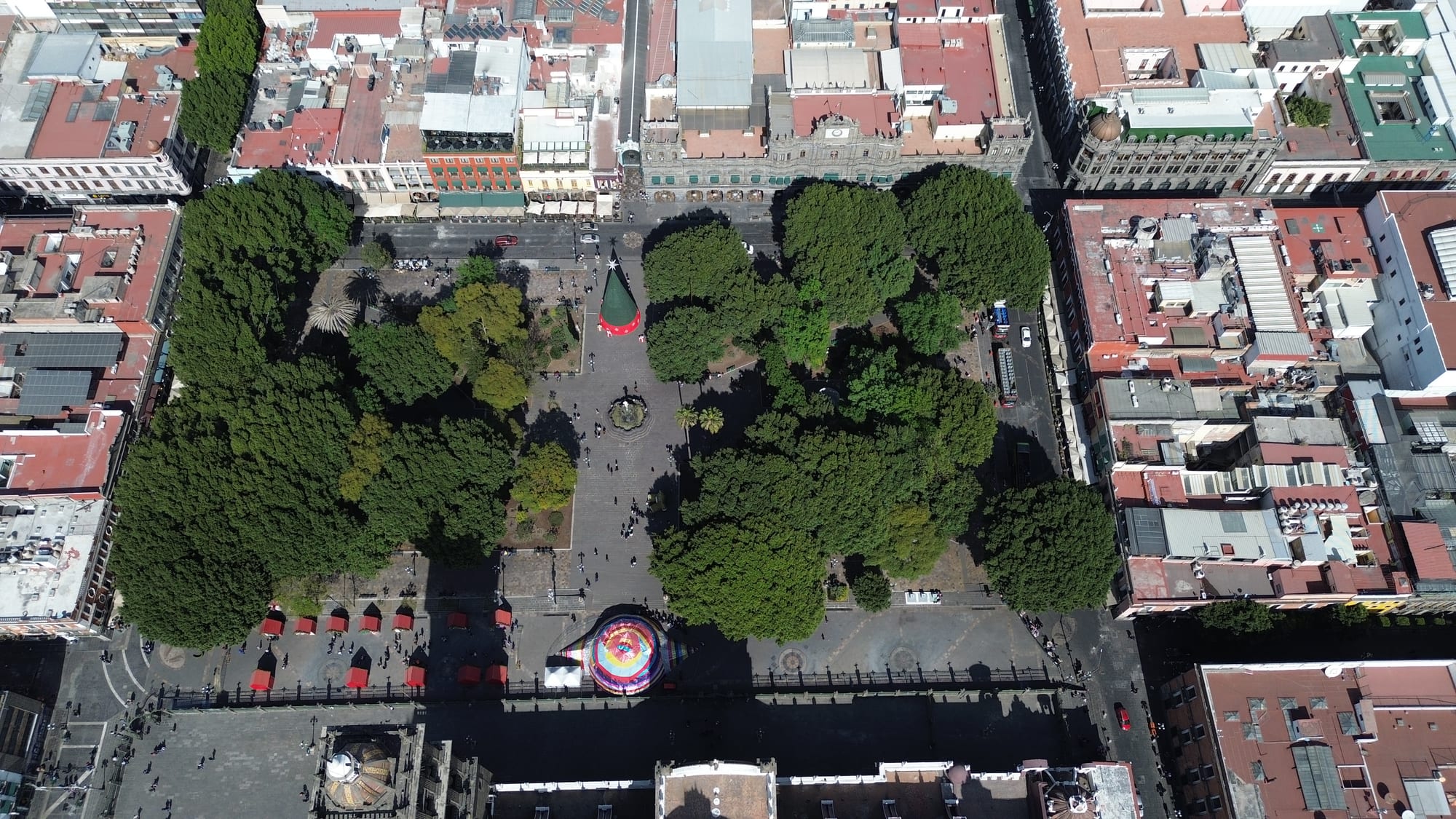
Aerial view looking down on Puebla's tree-filled main square, framed by streets and colonial buildings with red and white roofs

Mexico City & the Centre, Mexico

Puebla

The Zócalo of Puebla seen from above the cathedral. (Luisalvaz / Wikimedia Commons · CC0)

A colonial city founded by the Spanish in 1531 in a valley between Tlaxcala and Cholula, halfway between Mexico City and the port of Veracruz, with the snow-capped volcanoes Popocatépetl and Iztaccíhuatl to the west. Its centre of tiled façades and baroque churches is a World Heritage Site; today it is also a major car-making city and the home of mole poblano.

Neighbourhoods

  • Centro Histórico
    • First-time visitors
    • Historic district
    • Architecture

    The colonial grid around the Zócalo, laid out in the 16th century and listed by UNESCO in 1987. The cathedral, City Hall and the tiled Casa de los Muñecos face the square, and churches, museums and houses faced with Talavera tiles fill the surrounding blocks.

    Open in Maps
  • Barrio del Artista and Los Sapos
    • Arts and culture
    • Markets
    • Nightlife

    A few blocks from the Zócalo, the Barrio del Artista has studios where painters work in view of the public. Around the Callejón de los Sapos a flea market of crafts and antiques sets up on Saturdays and Sundays, and small bars and clubs open at night.

    Open in Maps
  • Cholula
    • Historic sights
    • Students and nightlife

    The ancient city on Puebla's western edge, now part of the metropolitan area, built around the Great Pyramid and the church on its summit. It has its own plazas, many churches and a lively student scene around the Universidad de las Américas.

    Open in Maps

Things to do

Churches and landmarks

  • Puebla Cathedrallandmark

    Begun in 1575 on the orders of Philip II and consecrated in 1649, with its north tower finished in 1678 and its south tower in 1768.

    Open in Maps
  • Chapel of the Rosariolandmark

    The chapel in the church of Santo Domingo, built between 1650 and 1690 and covered in gilded baroque decoration, often called a candidate for the eighth wonder of the world.

    Open in Maps
  • Estrella de Pueblaviewpoint

    An 80-metre observation wheel opened in 2013, once listed by Guinness as the world's largest portable observation wheel.

    Open in Maps

Museums and libraries

  • Biblioteca Palafoxianamuseum

    The library founded in 1646 by Bishop Juan de Palafox y Mendoza for the seminary, its tiers of old books listed by UNESCO in its Memory of the World register.

    Open in Maps
  • Museo Amparomuseum

    One of Mexico's leading museums of pre-Hispanic, colonial and modern art, opened in 1991 in two colonial buildings of the historic centre.

    Open in Maps
  • International Museum of the Baroquemuseum

    A museum of baroque art in a building designed by the Japanese architect Toyo Ito, opened in 2016.

    Open in Maps

Markets and crafts

  • El Pariánmarket

    The largest crafts market in the city, a short walk from the Zócalo, selling handicrafts from around the region.

    Open in Maps
  • Callejón de los Saposmarket

    A lane in the old centre where a flea market of crafts and antiques sets up on Saturdays and Sundays.

    Open in Maps

Cholula and the outskirts

  • Great Pyramid of Cholulalandmark

    The largest pyramid known by volume, 6.4 km west of the city of Puebla, now looking like a hill crowned by a church; about 800 metres of the archaeologists' 8 km of tunnels are open to visitors.

    Open in Maps
  • Iglesia de Nuestra Señora de los Remedioslandmark

    The 16th-century church on top of the Great Pyramid, decorated with 24-carat gilded panels and a major pilgrimage destination.

    Open in Maps
  • Africam Safaripark

    A safari park founded in 1972, about 17 km from the city, accredited by the main American and world zoo associations.

    Open in Maps

Seasonal events

  • Cinco de Mayo5 May

    The city's great civic holiday, celebrating the Mexican victory over the French army at the Battle of Puebla in 1862.

  • Chiles en nogada seasonlate summer

    The weeks when restaurants and homes prepare chiles en nogada, in the season of fresh walnuts and pomegranates.

Eat and drink

Long-standing places and food districts in Puebla. Hours, ratings and directions come from your maps app, always current.

Puebla classics

  • Mole and chiles en nogada in the historic centreneighborhood

    The restaurants of the old centre serve the city's two famous dishes: mole poblano over turkey or chicken, and chiles en nogada in season.

    Open in Maps
  • Mercado La Acocotamarket

    An indoor market listed among the city's places for street food.

    Open in Maps

Food streets and sweets

  • Cemitas and chalupas around the centreneighborhood

    Market stalls and small eateries sell the city's big sesame-bun cemitas and its cheese-free chalupas, small fried tortillas with green or red salsa and shredded meat.

    Open in Maps
  • Sweet shops of the centreneighborhood

    Shops selling Puebla's traditional sweets, among them camotes, rolls of sugared sweet potato.

    Open in Maps

Experience Puebla

History

The Spanish founded Puebla on 16 April 1531 in the valley of Cuetlaxcoapan, "where serpents change their skin". Unlike Mexico City it was not built on an Indigenous city: before the conquest the valley between Tlaxcala and Cholula had been left empty and used for the ritual "flower wars" between neighbouring peoples. The first site, beside the San Francisco River, flooded constantly, and most settlers moved from its west bank to higher ground. Placed midway between the capital and the port of Veracruz, surrounded by large Indigenous towns, the city grew fast; by the end of the century it covered 120 blocks, and the cathedral was begun in 1575.

In the 17th century Bishop Juan de Palafox y Mendoza founded his library in 1646, Juan Gutiérrez de Padilla, the leading composer of the New World, worked at the cathedral for some forty years, and the gilded Rosary Chapel was finished in 1690. Potters from Talavera de la Reina in Spain had arrived between 1550 and 1570, and their tin-glazed pottery and tiles, blended with local designs, became the city's signature.

On 5 May 1862 Mexican forces under Ignacio Zaragoza defeated the invading French army at the Battle of Puebla, and Benito Juárez renamed the city Puebla de Zaragoza. In the 20th century it grew into an industrial city, with the large Volkswagen plant in the metropolitan area. UNESCO listed the historic centre as a World Heritage Site in 1987. Old tunnels beneath the centre, long dismissed as legend, were rediscovered in 2015, and the 2017 earthquake damaged buildings across the state.

Culture & Customs

Puebla's identity rests on its colonial heritage and its crafts. Talavera — tin-glazed pottery in blue, yellow and other colours — covers domes, façades and kitchens across the city, and in 2019 the artisanal Talavera of Puebla and Tlaxcala, together with the Talavera tradition of Talavera de la Reina in Spain, was added to UNESCO's intangible heritage list. UNESCO has also named Puebla a City of Design. The Barrio del Artista keeps painters at work in the centre.

Religion is woven through daily life. Most Poblanos are Catholic, the historic centre is filled with colonial churches, and in the 17th century the cathedral was home to Juan Gutiérrez de Padilla, the leading composer of the New World. The great civic holiday is the 5 May, when the city celebrates the victory over the French in 1862.

The city is also a university town. The Benemérita Universidad Autónoma de Puebla, founded in 1587, is the oldest and largest university in the region, and the Universidad de las Américas in Cholula fields the "Aztecas" college American football team. Food is part of local pride: the city claims both mole poblano and chiles en nogada.

Daily Life

The Puebla–Tlaxcala metropolitan area, the fourth largest in Mexico, had 2,776,893 people at the 2020 census across 28 municipalities in the two states; the city itself had 1,542,232. It is one of the main hubs of east-central Mexico.

Industry dominates the economy. The Volkswagen plant in the municipality of Cuautlancingo is the company's largest factory outside Germany, Audi builds cars at San José Chiapa, and many suppliers to both have opened factories around the city; the steelmaker Hylsa is another big employer. Universities, commerce, government and tourism add to the mix.

Life in the centre follows a traditional rhythm: markets in the morning, a large comida in mid-afternoon, and evening strolls around the Zócalo. Shopping malls have multiplied, but the Zócalo remains the cultural, political and religious centre of the city. The volcano Popocatépetl, visible from the city, is a constant presence — its ash falls on the streets during active periods — and the region also lives with earthquakes; the city's growth, under way since the early 20th century, continued after the 1985 earthquake in the capital.

Food

Puebla is one of the great food cities of Mexico. Its best-known dish is mole poblano, a dark sauce of several dried chillies, chocolate, nuts, seeds and spices, served over turkey or chicken; many food writers consider turkey in mole poblano the pinnacle of Mexican cooking, and legend places its invention in a convent kitchen in the city. Chiles en nogada, said to have been invented here too, are stuffed poblano chillies covered in a white walnut sauce and scattered with parsley and pomegranate seeds to show the green, white and red of the flag; they are eaten in late summer.

Street food is just as distinctive. The cemita is a large sandwich named after its sesame-topped bun, filled with meat, avocado, Oaxaca cheese and the pungent herb pápalo, with chipotle chillies; the Victoria Market once made a famous version with beef hoof. Chalupas are small fried tortillas topped with green or red salsa, onion and shredded meat, traditionally without cheese, and tacos árabes, similar to kebabs and usually made of pork, are sold at stalls and even at the baseball stadium.

The city is also known for its sweets, including camotes, rolls of sugared sweet potato, and markets such as La Acocota sell prepared street food.

Planning tools

Budget

Puebla is cheaper than Mexico City for rooms and meals, and its sights are close together, so transport costs little. Hotels in the historic centre range from simple to boutique, and street food, markets and set-price lunches keep food bills low.

Daily Budget Midrange
USD 80–180 (boutique hotel in the centre, restaurant meals, museum entries and taxis)
Daily Budget Shoestring
USD 30–55 (hostel or simple hotel, market food and cemitas, city buses)

Visit Cholula as a short ride from Puebla rather than moving hotels; the churches, the Zócalo and the Barrio del Artista cost nothing to see.

Best Time to Visit

Mid-October to February is dry and temperate, and spring, from March to mid-May, is warm. From mid-May to mid-October is the rainy season, when afternoon storms are common. The 5 May holiday is a busy time, and late summer brings the season of chiles en nogada.

Suggested Number of Days

Two or three days are enough for the historic centre, its churches and museums. Allow another day or two for Cholula and the surrounding valley. Puebla can be seen from Mexico City in a long day, but the evenings in the centre are a reason to stay.

First Visit
2–3 days
With Surroundings
3–4 days

Transportation

The historic centre is best seen on foot. City buses, taxis and ride-hailing apps cover the rest of the city and the short trip to Cholula. First-class buses run frequently from the main bus station to Mexico City and other cities of central and southern Mexico.

Use apps or registered taxis, especially at night and from the bus station.

Airport & Station Connections

Puebla International Airport, officially Hermanos Serdán International Airport, is in Huejotzingo, west of the city, with national and some international flights. Most air travellers use Mexico City International Airport, less than 100 km west, which is well connected by highway and frequent buses; the bus ride from Mexico City's eastern terminal takes about two hours, depending on traffic.

Walkability

The historic centre is flat, laid out on a grid and easy to explore on foot, with the Zócalo, the cathedral, Santo Domingo, the Barrio del Artista and El Parián all close together. Outer districts and Cholula need a bus or taxi.

Safety

Safety varies enormously by state and even neighbourhood. The historic centre is busy and generally safe with ordinary care, but bag and phone theft happen in crowds and at bus stations. Popocatépetl, 40 km to the west, is an active volcano, and its ash sometimes falls on the city during active periods, most recently in May 2023. The region is also an earthquake zone: the 2017 earthquake struck about 55 km south of the city and caused damage in the state.

Use apps or registered taxis, keep valuables out of sight in crowds, and follow official alerts when Popocatépetl is active. Check current official travel advice before travelling.

Climate

Puebla lies high in the central highlands, so days are mild and nights cool all year, with a rainy season from about May to October that brings afternoon storms. Across the central highlands, days are about 22–27°C in summer and 18–23°C in winter, with cold nights at altitude.

Summer
mild with afternoon rain — about 22–27°C by day across the central highlands
Winter
dry and sunny — about 18–23°C by day across the central highlands, with cold nights

Local Customs

Most Poblanos are Catholic, and the many churches of the centre are working places of worship. Greet people with 'buenos días' or 'buenas tardes'. Tipping is customary in restaurants. The comida, the main meal, is eaten in mid-afternoon.

Dress modestly and keep quiet in churches, especially during Mass, and ask before photographing people at markets and in church.

Common Payment Methods

The currency is the Mexican peso. Cards are accepted in hotels, restaurants and larger shops, but markets, street stalls, small craft shops and buses need cash. ATMs are common in the centre; use those inside banks.