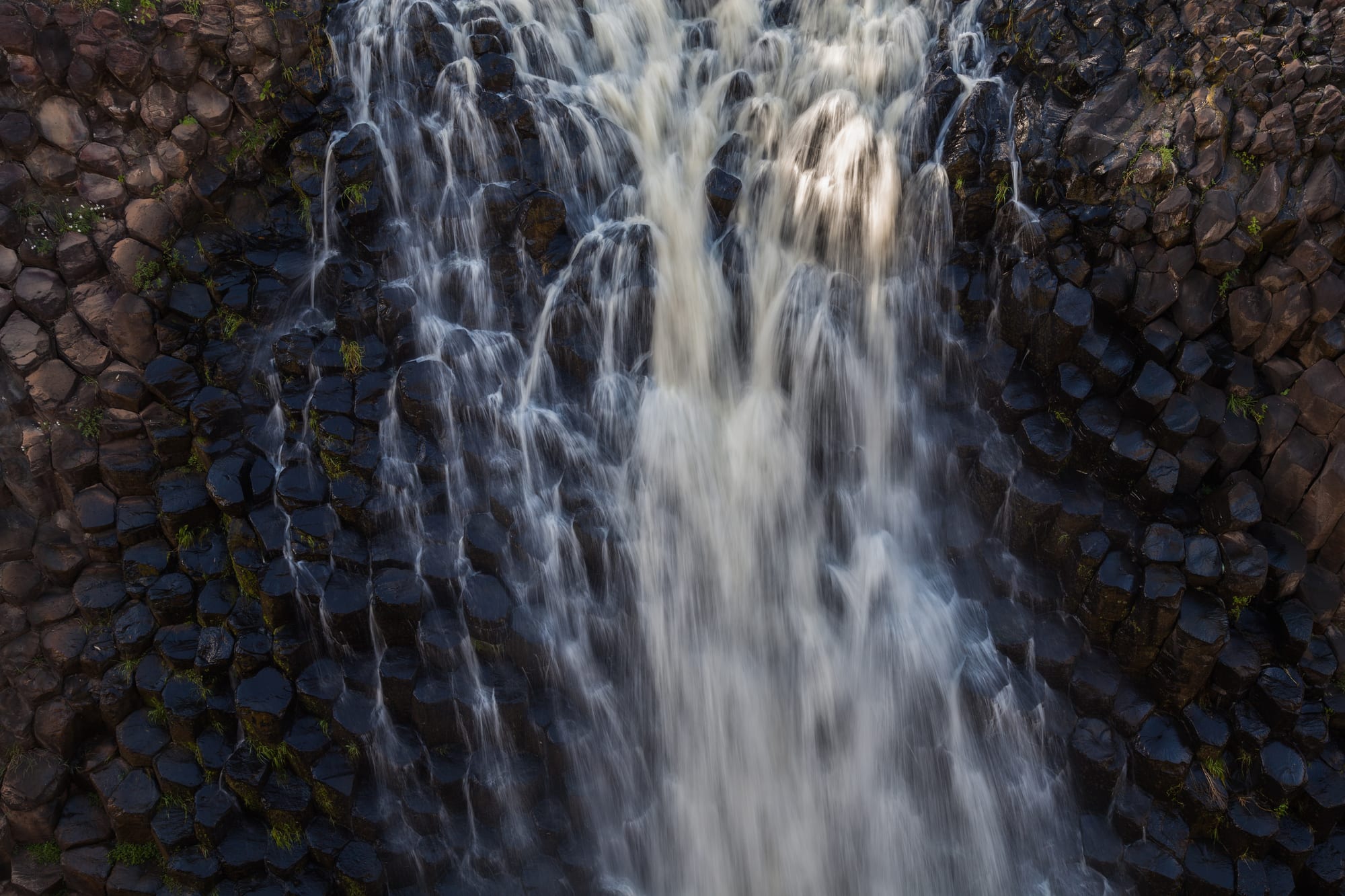
A white waterfall pouring over dark hexagonal basalt columns, their tops forming a honeycomb pattern

Mexico City & the Centre, Mexico

Huasca de Ocampo

Water falling over the basalt columns of the Basaltic Prisms near Huasca de Ocampo. (Diego Delso / Wikimedia Commons · CC BY-SA 3.0)

A small Hidalgo town of white sandstone houses and red roofs at the edge of the Sierra de Pachuca, 34 km from Pachuca. Its wealth came from the silver-processing haciendas built by Pedro Romero de Terreros in the 18th century; today it is a farming community and, since 2001, a Pueblo Mágico visited for its basalt columns, canyons, dams and trout.

Neighbourhoods

  • The town centre
    • First-time visitors
    • Historic district
    • Crafts

    Narrow streets of white sandstone houses with pitched red roofs around the parish church of John the Baptist. Potters and other craft sellers have shops under the portals north of the church, and the Casa de Cultura to its south also sells local crafts.

    Open in Maps
  • The canyons and haciendas
    • Nature
    • Walks
    • Quiet stays

    Outside the town the land drops into a wide valley of farms, dams and canyons, where the basalt prisms, trout farms and the old mining haciendas — several now converted into hotels — are scattered among small communities such as San Miguel Regla.

    Open in Maps

Things to do

Canyons and waterfalls

  • Basaltic Prisms of Santa María Reglaattraction

    A ravine lined with polygonal basalt columns 30 to 50 metres high, formed by slowly cooling lava, with waterfalls fed by water from the San Antonio dam; Alexander von Humboldt sketched them in 1803.

    Open in Maps
  • Peña del Aireviewpoint

    An enormous basalt rock jutting from the side of a canyon just north of the old Santa María Regla hacienda, above a river that flows on to the San Sebastián canyon.

    Open in Maps
  • Aguacatitla Canyontrail

    A branch of the San Sebastián canyon, a few kilometres from San Miguel Regla.

    Open in Maps

In and around the town

  • Parish church of John the Baptistlandmark

    The church at the centre of town, founded in the first half of the 16th century by Augustinians from Atotonilco el Grande; the relief of the Archangel Michael over its doorway leads many to think it is his.

    Open in Maps
  • Museo de los Duendesmuseum

    A small museum just outside town devoted to stories of goblins and similar creatures from around the world, with many figures made from horsehair.

    Open in Maps
  • Trout Parkpark

    A trout farm built by local ejidos on their communal land, with the fish raised from imported eggs because the water is slightly too cold for them to spawn.

    Open in Maps

Short trips from the town

  • Real del Monteattraction

    The mining town 16 km away on a mountain pass at about 2,700 metres, the highest town in Hidalgo, whose Cornish miners brought pastes to the region.

    Open in Maps
  • Pachucaattraction

    Hidalgo's state capital, 34 km away, an old silver-mining city.

    Open in Maps

Seasonal events

  • Feast of John the Baptist24 June

    The festival of the town's patron saint, celebrated at the parish church.

Eat and drink

Long-standing places and food districts in Huasca de Ocampo. Hours, ratings and directions come from your maps app, always current.

Huasca classics

  • Trout restaurantsrestaurant

    Trout farms in the valley have small rustic restaurants that prepare the fish in various ways; at some, visitors can catch their own.

    Open in Maps
  • Town marketmarket

    The market and the town's restaurants serve baked trout, cecina, barbacoa, pastes and quesadillas with huitlacoche.

    Open in Maps

Food districts and markets

  • Restaurants around the plazaneighborhood

    The streets around the parish church have the town's restaurants and shops selling pulque bread, fruit wines and rompope.

    Open in Maps

Experience Huasca de Ocampo

History

Huasca lies where the Sierra de Pachuca meets the western end of the Tulancingo valley. Augustinians from the monastery at Atotonilco el Grande founded its parish church in the first half of the 16th century, and one of the first haciendas established in Mexico, a farming and livestock estate, was founded here. By the 17th century the encomienda had been broken up and the lands around the Indigenous town became haciendas.

The town's great period came in the 18th century with Pedro Romero de Terreros. His mines here and in Pachuca and Real del Monte made him the richest man in the world at the time, and he built four mining haciendas in the valley to process the ore, at a cost of two million pesos; one of them employed up to 2,000 workers, and he died at his residence here in 1781. Alexander von Humboldt visited in 1803 and sketched the basalt prisms that were then part of the estate. By 1810 the output of the mines had fallen by almost 80 per cent, and agriculture became the mainstay.

In the 20th century the haciendas were broken up into ejidos, land held in common by rural communities, and dams built to store water and generate electricity for Pachuca flooded parts of them, leaving one almost entirely under water. Several of the old buildings became hotels, and the area's haciendas and landscapes have served as sets for films such as The Mask of Zorro. In 2001 Huasca became the first town in Hidalgo to join the federal Pueblos Mágicos programme, chosen because its old buildings survive and its pace of life has changed little.

Culture & Customs

Huasca's appeal lies in its preserved small-town character: houses of white sandstone with pitched roofs of red tile or laminate, a parish church at the centre, and a pace of life that has changed little since the early 20th century. Many people assume the church is dedicated to the Archangel Michael, because of the carving above its main door, but its patron is John the Baptist, whose feast on 24 June is the town's main festival.

The town is known for its pottery made with local red clay, sold in workshops under the portals north of the church, and for other crafts: hats, molcajete grinding bowls carved from volcanic stone, furniture, wrought iron and obsidian objects. The Casa de Cultura, south of the church, also sells local work.

Local legend has a playful place too. The Museo de los Duendes, just outside town, collects stories of goblins and similar creatures from around the world, inspired by a tale that a group of friends camping nearby in 1994 met goblins who were angry at mankind's destruction of nature. Few people in the municipality now speak an Indigenous language — 64 in the 2005 census.

Daily Life

The municipality had 17,607 people at the 2020 census, and only a small share of them live in the town itself; most live in villages spread across the valley. Agriculture is still important, employing over 37 per cent of the population, with manufacturing, construction and mining employing about 28 per cent and commerce, including tourism, about 35 per cent. Local products include processed foods, drinks and animal feed.

The landscape shapes daily life. About 3,300 hectares of forest cover the Sierra de Pachuca around the town, and rivers and streams feed 87 natural and dammed bodies of water, the best known being the San Antonio Regla dam, whose water mainly irrigates farms. Ejidos run trout farms, parks and other attractions on their communal land.

State and local authorities have promoted tourism, and Huasca fills with visitors from Mexico City at weekends. That popularity has brought property disputes between residents and outsiders seeking to buy or control land, especially around the old haciendas. On weekdays the town is quiet, and life turns on farming, the market and the church.

Food

Huasca's food is that of the Hidalgo highlands. Trout is the local speciality, raised in farms on ejido land and in the valley's cold streams and lakes; small rustic restaurants at the farms prepare it in various ways, baked among them, and at some visitors can catch their own fish before it is cooked.

At the market and in the town's restaurants the regional dishes appear too: barbacoa, meat slow-cooked in a pit; cecina, thin salted and dried beef; quesadillas filled with huitlacoche, the corn fungus prized as a delicacy; and pastes, the pasties introduced by Cornish miners at nearby Real del Monte and Pachuca and now a Hidalgo staple.

Sweet things and drinks round out the list. Pulque bread, made with the fermented sap of the maguey, is sold in town, along with local fruit wines and rompope, an eggnog-like drink. The region's pulque, the milky drink from which the bread takes its name, is still made in Hidalgo.

Planning tools

Budget

Huasca is inexpensive on weekdays, when the town is quiet. It is a weekend escape for residents of Mexico City, and room prices and crowds rise on Saturdays, Sundays and holidays. Entry fees to the canyons and parks are small, and market meals cost little.

Daily Budget Midrange
USD 85–200 (room in a converted hacienda or country inn, restaurant meals, site entries, taxis between sights)
Daily Budget Shoestring
USD 35–60 (simple guesthouse or cabin, market food, regional buses)

Come midweek for quieter sights and lower room prices.

Best Time to Visit

October to April is the dry season across the central highlands, with clear days and cold nights at this altitude; the rainy season runs from about May to October. The patron-saint festival falls on 24 June, and weekends are always busier than weekdays.

Suggested Number of Days

One or two days covers the town and the canyon sights around it. Adding the neighbouring mining towns makes two or three. The sights are spread out, so time depends on having a car.

First Visit
1–2 days
With Surroundings
2–3 days

Transportation

The town centre is small, but the prisms, canyons, dams and trout farms are scattered across the municipality, and a car, a taxi or a local tour is the practical way to reach them. Local colectivos link the town with the nearby communities.

Roads in the mountains are narrow and winding; drive by day.

Airport & Station Connections

Huasca lies 34 km from Pachuca, the state capital, and 16 km from Real del Monte. Visitors usually come by road from Mexico City via Pachuca, by car or by bus with a change there. The nearest major airports are those of Mexico City.

Walkability

The centre of town is compact and walkable, with the church, the plaza and the craft shops close together. The main natural sights lie several kilometres outside town and are not easily reached on foot.

Safety

Safety varies enormously by state and even neighbourhood. Huasca is a small rural town visited mainly by domestic weekend tourists. The natural sights involve steep canyon paths and fast water.

Keep to marked paths at the prisms and canyons, travel by day on mountain roads, and keep valuables out of sight. Check current official travel advice before travelling.

Climate

The town stands at about 2,090 metres, and its climate is temperate to mildly cold, with an average annual temperature of 15°C. The valley that opens east of the town is lower and warmer.

Summer
the rainy season; no source gives monthly figures, but the town's average annual temperature is 15°C
Winter
the dry season, with an average annual temperature of 15°C and cold nights at this altitude

Local Customs

Huasca is a small, conservative farming town. Modest dress is expected in the church. Much of the land around the sights belongs to ejidos, communities that hold land in common, and some sights are run by them. A tip is customary in restaurants.

Ask before photographing people, and respect fences and signs on communal land.

Common Payment Methods

The currency is the Mexican peso. Cash is needed for most restaurants, market stalls, craft shops and entry fees; cards are taken at larger hotels. Carrying enough pesos from Pachuca or Mexico City avoids problems.